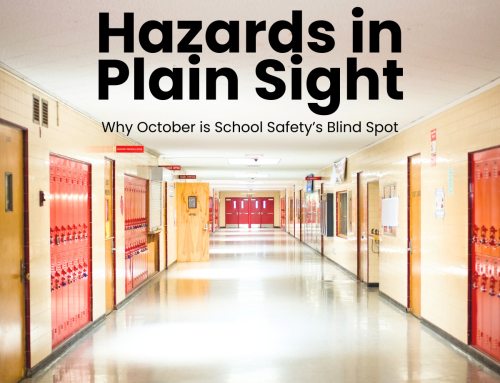
School safety culture doesn’t collapse all at once. It erodes quietly, one missed walkthrough at a time.
Every district leader knows the checklist. Post the Emergency Operations Plan. Train the staff. Run the drills. Check the boxes.
And then, slowly, something shifts. The walkthroughs get shorter. The safety meetings become formalities. The hazards that were flagged last semester are still sitting in someone’s inbox.
This isn’t negligence, it is human nature and complacency. And it’s the silent threat that no technology purchase, policy update, or compliance audit can fully address on its own.
Below, we answer the questions district leaders are actually asking about school safety complacency, why it happens, and what it actually takes to build a culture where safety is practiced, not just documented.
What is school safety complacency, and why does it happen in K-12 schools?
School safety complacency is the gradual erosion of attentiveness to safety protocols and physical hazards. Not because leaders stop caring, but because familiarity breeds inattention.
When staff walk the same hallways every day, they stop truly seeing them. A propped-open side door that was flagged in September becomes invisible by November. A broken exterior light that was noted during a walk doesn’t make it to a work order because the system for doing that is cumbersome. Over time, the gap between what leaders know they should do and what they actually do widens.
Research in organizational psychology calls this normalization of deviance: the gradual process by which teams come to accept small deviations from safety standards as normal. In schools, it surfaces as the principal who stopped doing weekly walkthroughs because there’s always something more urgent, or the assistant principal who stopped documenting observations because the report takes 15 minutes nobody has.
Complacency doesn’t announce itself. That’s what makes it dangerous.
How does school safety complacency differ from a lack of training or resources?
This is one of the most important distinctions in school safety leadership.
Untrained staff don’t know what to do and under-resourced staff lack the tools to do it. Complacent staff know what to do, have what they need, and still aren’t doing it consistently.
That’s a different problem, and it needs a different fix. More training or more checklists won’t solve it. What actually shifts behavior is a mix of habit formation, accountability, and reinforcement.
The same mechanics that drive consistency in any other area of school leadership.
Most school safety platforms are built for the first two problems: training and resources. Very few are designed to address the third.
What are the warning signs that safety complacency has set in at a school or district?
Leaders should watch for these signals:
Declining observation frequency. If your district ran 40 safety walkthroughs in September and 12 in February, that’s not seasonal variation. That’s a culture problem.
Repetitive hazard reports. When the same issues appear in observation logs month after month without resolution, it signals a breakdown in the feedback loop between safety observation and facilities response.
Documentation that lives in folders, not conversations. If your Emergency Operations Plans were last discussed during the annual compliance review, they are not part of your safety culture, they’re just a part of your compliance paperwork.
Leadership assuming instead of verifying. “We do walkthroughs” is not the same as “I can show you that we do walkthroughs, who does them, what they found, and what happened next.”
Can school safety really be turned into a culture rather than a compliance exercise?
Yes, but only if the systems around safety reflect how school leaders actually work.
Culture doesn’t live in your policy binder, but in the decisions people make when no one is watching. It’s the habits people maintain on a Tuesday in March, not just the procedures performed during inspection season.
Building a genuine safety culture in a K-12 district requires three things that most compliance-focused approaches lack:
Repetition that’s fast enough to sustain. If logging a safety observation takes 10 minutes, it won’t become a habit. If it takes 15–20 seconds on a phone, it can happen during any supervision moment: a hallway transition, a lunch duty, an early morning walkthrough. Speed is the difference between a task and a habit.
Visibility that creates accountability. When district leaders can see who is doing walkthroughs, what they’re finding, and how frequently, safety becomes a professional expectation — not a personal virtue.
Recognition that reinforces the right behaviors. Complacency thrives in environments where safety vigilance goes unnoticed. Culture forms when leaders who notice and document hazards are recognized, not just the ones who respond to incidents.
How should district leaders talk about safety culture with their principals?
The most effective conversation isn’t about compliance. It’s about leadership identity.
Principals who are highly engaged in safety walkthroughs don’t think of themselves as “doing safety.” They think of themselves as leaders who know what’s happening in their buildings. The walkthrough isn’t a chore; it’s how they stay connected to the physical environment their students and staff occupy every day.
Framing matters. “You need to complete more observations” is a compliance conversation. “We want every principal in this district to be the most informed person in their building about what’s safe and what isn’t” is a leadership conversation.
What role does technology play in reducing school safety complacency?
Technology can’t create safety culture, but the right technology can make the habits that build safety culture far easier to maintain.
The key question to ask about any school safety platform is: does it reduce friction or add it?
Platforms that require office visits, lengthy forms, or separate logins for different functions don’t become habits. They become obligations. Things staff do when someone is checking, and skip when no one is.
The platforms that actually change behavior are the ones embedded in how leaders already move through their day. A tool that lets a principal log a hazard observation with a photo in 15 seconds from the hallway will get used. A tool that requires going back to the office and filling out a form will not.
Technology also plays a critical role in closing the loop between safety observations and facilities response. One of the most demoralizing experiences for a safety-conscious staff member is logging a hazard and watching nothing happen. When a safety observation can trigger a maintenance work order in the same action, from the same device, the feedback loop closes and vigilance feels worthwhile.
What is an Emergency Operations Plan (EOP), and why do most districts struggle to keep theirs current and useful?
An Emergency Operations Plan is a district or school-level document that outlines procedures, protocols, and responsibilities for responding to emergencies, ranging from severe weather and medical events to active threats and campus lockdowns.
The challenge isn’t writing one. Most districts have EOPs. The challenge is that EOPs are often:
- Inaccessible in a real emergency. Stored in a binder in the main office, or in a shared drive no one has logged into since the last update.
- Out of date. Staff turnover, facility changes, and updated state guidance mean EOPs need regular review and that review rarely happens on schedule.
- Unknown to the people who need them. If a principal hasn’t reviewed their EOP since last year’s training, they won’t execute it confidently under pressure.
An EOP that no one can find or recall under stress is not a safety resource. It’s a liability documentation tool. The goal is to make EOPs living documents that are accessible from any device, regularly reviewed, and familiar to the leaders who will need to act on them.
How can SchoolDog help districts address safety complacency and build lasting safety culture?
SchoolDog was built specifically to solve the problems that generic safety platforms and compliance tools leave unaddressed.
The Awareness Walk Tool makes observation logging fast enough to become a genuine habit. 15 to 20 seconds, from any device, with photos. The more it’s used, the sharper staff awareness becomes. Repeated use isn’t just documentation; it’s training the eye to see what complacency makes invisible.
The EOP Management Platform ensures that Emergency Operations Plans are accessible from any device, can be shared with state and local EMA partners, and remain compliant without requiring a separate workflow to manage them.
Integrated Work Orders close the feedback loop that kills motivation: when a staff member logs a hazard, they can submit a maintenance work order in the same step, from the same location. No office trips. No separate systems. The problem gets logged, routed, and resolved.
Motivation and Communication Tools including monthly leaderboards, automated nudges, and district-wide alerts that build the consistency that turns safety from a compliance requirement into how your district operates.
SchoolDog is built by people who have served in K-12. It was designed for the way school leaders actually work. Not for the way compliance frameworks assume they work.
Ready to see what a safety culture platform actually looks like in practice?
In 30 minutes, you’ll see how SchoolDog helps district leaders reduce human error, build vigilance habits, and turn school safety from a compliance burden into embedded culture — before a crisis ever occurs.